


In her farewell lecture at the University of Graz, Barbara Gasteiger-Klicpera took stock of her academic career.
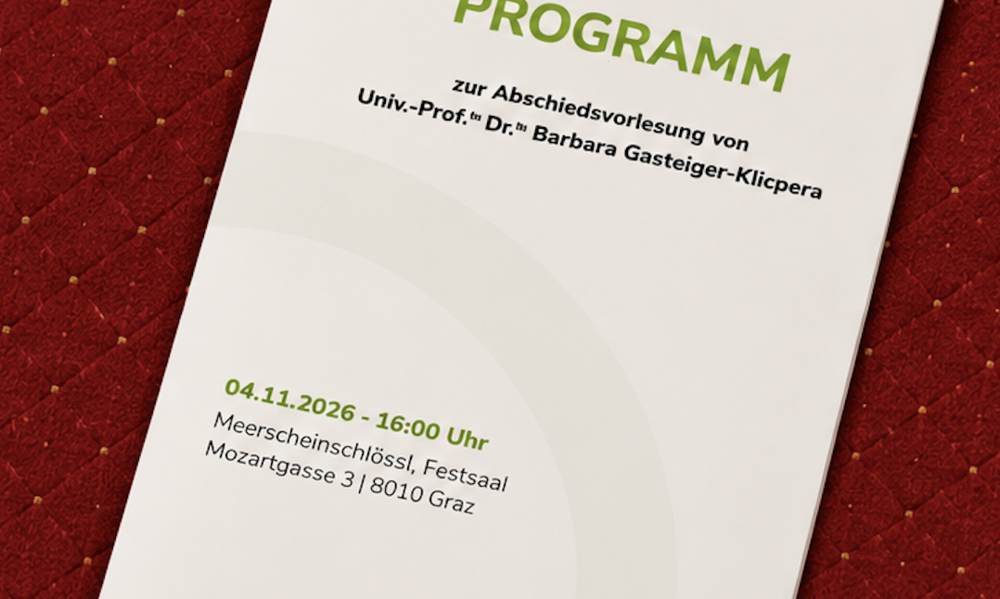
How can research help to turn inclusion from a vision into a lived reality? Barbara Gasteiger-Klicpera addressed this question on 4 November 2026 during her farewell lecture at the Meerscheinschlössl at the University of Graz. Under the title ‘From Vision to Reality – What Does Inclusion Research Achieve?’, she gave more than 100 attendees an insight into the diversity of her research work. The focus was on her commitment to advancing the further development of inclusion through academic findings and data.
Academic impetus and sustainable structures
Vice-Rector Catherine Walter-Laager of the University of Graz paid tribute to Barbara Gasteiger-Klicpera’s outstanding achievements in teaching and research, her numerous publications and projects, and her strong team spirit.
Rector Andrea Seel expressed her gratitude for the many years of excellent collaboration with the PPH Augustinum and for the groundwork laid for the Research Center for Inclusive Education (FZIB), which has placed this partnership on a stable footing.
Andrea Steiner, Dean of the URBI Faculty, emphasised how, since her appointment in 2010, Barbara has played a key role in shaping the URBI Faculty, the Institute for Educational Research and Teacher Training, and the Unit of Inclusive Education, later renamed Inclusive Education and Special Educational Psychology. During her eight years as Dean, Barbara Gasteiger-Klicpera also provided lasting impetus: she laid the foundation stone for the House of Educational Sciences at Universitätsplatz 4, which will be occupied following the refurbishment of the building in February 2027.
On behalf of the entire FZIB team, David Wohlhart expressed his gratitude for the productive collaboration and its outcomes, which have made a lasting contribution to strengthening research into inclusion.
Lisa Paleczek and Susanne Seifert, who, following their appointments as professors, are succeeding Barbara Gasteiger-Klicpera as heads of the Inclusive Education Research Group and the Centre for Empirical Research in Inclusion, which she founded, paid tribute, on behalf of the entire department and centre team at the university, to the tireless dedication of their former head. For many, this intensive collaboration has paved the way to an academic career.
From special educational needs to digital tools
In her farewell lecture, Barbara Gasteiger-Klicpera covered a wide range of her research topics: from issues relating to special educational needs and the mental health of children and young people, through a doctoral programme on language and reading skills, to open educational resources (Open Educational Resources) for inclusive teaching. Another topic was a digital tool for detecting dementia in people with intellectual disabilities, for which the project team had recently been awarded the Salus 2026 prize by the Styrian Health Fund. The diversity of this work clearly highlighted the common thread running through her academic career: research and data should contribute to the further development of inclusion. Barbara Gasteiger-Klicpera’s lifetime of scientific work thus stands as a testament to inclusion in practice – underpinned by outstanding scientific research, extensive commitment, collaboration and the support of early-career researchers.